
Quick Answer
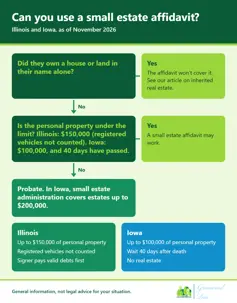
A small estate affidavit lets family collect a loved one's bank accounts and other personal property without opening probate. In Illinois, it covers up to $150,000, not counting registered vehicles. In Iowa, it covers up to $100,000 once 40 days have passed. Neither state lets you use it for a house.
Key points
- Only assets that would otherwise go through probate count toward the limit.
- Accounts with a named beneficiary or a surviving joint owner usually pass outside the affidavit entirely.
- The person who signs promises to pay the estate's bills first and answers for mistakes.
- Real estate needs a different route in both states, and in Iowa that route is usually probate.
Is this you?
- Someone close to you died, and a bank or company is asking for "letters" or a court order.
- The estate looks modest, and you'd rather not open a court case.
- You aren't sure whether the house changes the answer.
What is a small estate affidavit?
It's a sworn statement, signed in front of a notary, that tells a bank or other holder who is entitled to the decedent's property. The holder can release the property to the people named without a judge's order. Both Illinois and Iowa have one, and the rules differ in ways that matter.
Illinois and Iowa side by side
| Illinois | Iowa | |
|---|---|---|
| Limit | $150,000 of personal property | $100,000 of personal property |
| Vehicles | Not counted toward the limit; the affidavit can also be used just to retitle a vehicle | Counted; county treasurer has its own vehicle affidavit |
| Waiting period | None stated | 40 days after death |
| Real estate | Not covered | Not covered; probate assets must be personal property only |
| Next step up | Probate | Small estate administration (up to $200,000), then full probate |
Illinois raised its limit from $100,000 to $150,000 for deaths on or after August 15, 2025. Iowa raised its limit from $50,000 to $100,000 in 2026.
What counts toward the limit?
Only probate assets count: property in the decedent's name alone with no beneficiary or surviving co-owner. These usually pass outside the affidavit and don't count:
- Joint accounts with a surviving owner
- Payable-on-death and transfer-on-death accounts
- Life insurance and retirement accounts with a named beneficiary
- Assets held in a living trust
Many estates that look large on paper qualify once these come out of the total.
What about the house?
In both states, title to the decedent's real estate passes to the heirs or the people named in the will at the moment of death. Proving that ownership so the house can be sold or refinanced is the hard part, and the small estate affidavit can't do it in either state.
Illinois families have several routes, including an affidavit of heirship signed by all heirs. In Iowa, a house owned in one person's name almost always goes through probate unless a joint owner survives. Our article, Who Owns a House After Someone Dies in Illinois or Iowa?, walks through both states.
Who signs, and what are they promising?
In Illinois, the person who signs (the affiant) lists the decedent's debts and promises to pay valid claims before anyone inherits. If something goes wrong, the affiant must make creditors and heirs whole, up to the loss they caused. In Iowa, a successor signs under penalty of perjury and takes responsibility for paying creditors from what they receive. Either way, signing is a real legal commitment.
When the affidavit is the wrong tool
- The decedent owned real estate in their name alone.
- The family disagrees about who inherits.
- There are debts larger than the assets, or debts you can't identify.
- In Iowa, the decedent received Medicaid, which can create an estate recovery claim.
In these cases, probate protects the person handling the estate as much as it protects anyone else.
More in this series
- Illinois Small Estate Affidavit: Who Qualifies for $150,000
- How to Fill Out the Illinois Small Estate Affidavit
- Can an Illinois Small Estate Affidavit Transfer a House or Car?
- What If the Bank Won't Accept My Small Estate Affidavit?
- Small Estate Affidavit Mistakes That Make You Personally Liable
- Iowa Small Estate Affidavit: $100,000 Limit and 40-Day Wait
- Iowa Small Estate Administration for Estates Under $200,000
Next step: Not sure which path fits your family? Leave your contact details and a short note in our chat, and our team will reach out.
Reviewed by James D. Greenwood, November 11, 2026. Sources: 755 ILCS 5/25-1 (as amended by P.A. 104-0346); Iowa Code 633.356 (as amended by 2026 Iowa Acts ch. 1048); Iowa Code ch. 635.
This post is general information, not legal advice for your situation.