
Quick Answer
A person named as agent under a power of attorney is a fiduciary. They must act in good faith for the principal, stay within the powers granted, keep records, and avoid using the principal's money for themselves without authority. When family members see warning signs, they can request records, report suspected exploitation, and ask a court to order an accounting or remove the agent.
Key points
- Illinois and Iowa both give courts power to review an agent's conduct.
- Family members are among those who can ask the court to act.
- Money taken improperly can often be recovered.
- The agent's authority ends at the principal's death.
Is this you?
- A sibling or other relative controls a parent's money and won't explain where it's going.
- Bills are going unpaid, or a parent's savings dropped fast.
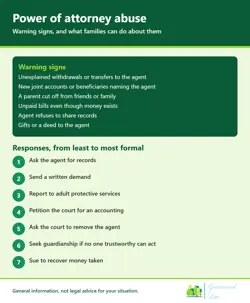
Warning signs
- Large or frequent withdrawals, transfers, or checks to the agent or the agent's family.
- New joint accounts or changed beneficiaries naming the agent.
- A deed of the parent's house to the agent.
- Unpaid bills or care even though money exists.
- The agent refuses to share any information.
- The parent is cut off from friends or family.
The response ladder
- Ask the agent for records.
- Send a written demand.
- Report suspected exploitation to adult protective services.
- Petition the court to review the agent and order an accounting.
- Ask the court to suspend or remove the agent.
- Pursue guardianship if no one trustworthy can act.
- Sue to recover money taken.
More in this series
- What Can a Power of Attorney Agent Legally Do in Illinois?
- What Can a Power of Attorney Agent Legally Do in Iowa?
- Can a POA Agent Pay Themselves or Make Gifts?
- How to Demand an Accounting From a POA Agent in Illinois
- How to Demand an Accounting From a POA Agent in Iowa
- How to Revoke or Remove a Power of Attorney Agent
- Getting Back Money Taken by a POA Agent
- Reporting Financial Exploitation of an Older Adult
Related series: Adult Guardianship in Illinois and Iowa: An Overview.
Next step: Concerned about an agent's conduct? Leave your contact details and a short note in our chat, and our team will reach out.
Reviewed by James D. Greenwood, November 11, 2026. Sources: Illinois Power of Attorney Act, 755 ILCS 45/2-7, 2-10; Iowa Uniform Power of Attorney Act, Iowa Code 633B.114, 633B.116.
This post is general information, not legal advice for your situation.