
Quick Answer
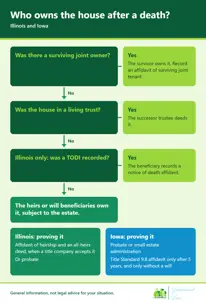
In both Illinois and Iowa, a house passes at the moment of death to a surviving joint owner, a trust, an Illinois TODI beneficiary, or, if none of those apply, the heirs or will beneficiaries. When it passes to the heirs, ownership is subject to the estate's debts, and the record still shows the decedent. Clearing that record is easier in Illinois than in Iowa.
Key points
- Joint tenancy and trusts keep the house out of probate in both states.
- Illinois allows transfer on death instruments (TODIs) for real estate. Iowa has no equivalent.
- In Illinois, all heirs can sometimes deed the house using an affidavit of heirship.
- In Iowa, a house in one person's name almost always goes through probate unless a joint owner survives.
Is this you?
- A parent or relative died owning a house, and you need to sell it, live in it, or refinance it.
- The deed is still in the decedent's name.
Four ways a house passes at death
- To a surviving joint owner. If the deed created a joint tenancy with right of survivorship, or in Illinois a tenancy by the entirety between spouses, the survivor owns the whole house immediately.
- To a trust. If the house was deeded to a living trust, the successor trustee manages or sells it under the trust's terms.
- By TODI (Illinois only). A recorded transfer on death instrument names who receives the house at death.
- To the heirs or will beneficiaries. If none of the above applies, ownership passes to the people named in the will, or to the heirs under state law if there's no will.
Why the paperwork still matters
When the house passes to the heirs, the record still shows the decedent as owner. A buyer, lender, or insurer wants proof of who owns it now and that the estate's debts won't attach to it. Until that proof is on the record, the house is hard to sell, refinance, or sometimes even insure.
Illinois and Iowa side by side
| Illinois | Iowa | |
|---|---|---|
| Joint tenancy, trust | Passes outside probate | Passes outside probate |
| TODI for real estate | Yes | No |
| Heirs deed without probate | Sometimes, with an affidavit of heirship and title company approval | Rarely; title opinions generally require probate |
| Simplified court option | Independent administration | Small estate administration up to $200,000 |
| Long-wait option | None needed | Title Standard 9.8 affidavit, 5+ years after an intestate death |
While ownership gets sorted out
Someone still has to pay the mortgage, taxes, and insurance, and keep the house secure. Those costs often fall on the heirs, or on the estate if probate is open. If heirs disagree about selling, a court can step in.
More in this series
- Do Heirs Automatically Own a House in Illinois?
- Illinois Affidavit of Heirship for a House Without Probate
- Illinois TODI: What the Beneficiary Does After a Death
- Selling an Inherited House in Illinois, Step by Step
- Can You Avoid Probate on an Iowa House?
- Iowa Title Standard 9.8: A House Five Years After Death
- Selling a House Through Iowa Probate, Step by Step
- Surviving Joint Owner: Clearing Title After a Death
- Who Pays the Mortgage and Taxes on an Inherited House?
- When a Sibling Lives in the Inherited House or Won't Sell
Next step: Not sure how your family's house passes? Leave your contact details and a short note in our chat, and our team will reach out.
Reviewed by James D. Greenwood, November 11, 2026. Sources: 755 ILCS 5/20-1; 755 ILCS 27 (Real Property Transfer on Death Instrument Act); Iowa Code 633.350, 633.413; Iowa Code ch. 635.
This post is general information, not legal advice for your situation.