
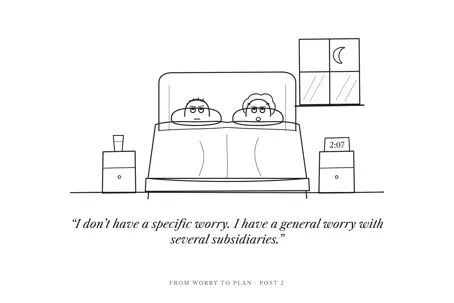
The short version: A worry is a vague feeling that something could go wrong. A risk is that same feeling with a name on it, and named risks are the ones a plan can solve.
Two kinds of people walk into my office more than any others.
The first is a young couple. Maybe they just had a baby, or there's one on the way. They're tired, they're a little overwhelmed, and somewhere around 2 a.m. one of them thought, "What happens to this kid if something happens to us?"
The second is a couple in their late 60s. The kids are grown and gone, living their own lives. They're starting to think about what comes next, and one of them says, "I just don't want the kids fighting when we're gone."
Different stages of life. Same feeling underneath: something could go wrong, and I'm not sure what.
That feeling is a worry. And here's the thing about worries. You can't fix them.
You can fix a risk.
So what's the difference?
A worry is foggy. It sits in the back of your mind and doesn't have a shape. "I want the kids taken care of" is a worry. It's a good worry. It's the right worry. It just needs unpacking before I can draft anything to solve it.
A risk has a name. "If we both die in a car accident, we don't know who would raise our daughter" is a risk. "My son would inherit $200,000 at 18 and I don't think he's ready for that" is a risk. "My two kids already disagree about what to do with the house" is a risk.
Once something has a name, we can do something about it. That's really most of what estate planning is. You come in with worries, and together we turn them into a list of named problems. Then we solve them, one at a time.
What a worry looks like when you unpack it
Let's take that young couple. "We want the kids taken care of" turns into a handful of real questions:
Who raises the kids if both of you are gone?
Who manages the money for them? (That doesn't have to be the same person.)
When do the kids get the money, and how much at a time?
If one of you is in the hospital and can't make decisions, who makes them?
If you don't answer those questions, the law answers them for you. In both Illinois and Iowa, a court would pick a guardian. Money left to a minor would generally sit with a court-supervised guardian (Iowa calls it a conservator) until the child turns 18, and then it's theirs, all of it, all at once. A custodial account under the Uniform Transfers to Minors Act skips the court oversight, but it usually hands everything to the child at 21. I've met a lot of great 18-year-olds. I haven't met many I'd hand a life insurance check to.
Now the couple in their 60s. "I don't want the kids fighting" unpacks into questions like:
Who's in charge of your affairs if you can't be, before you die?
Who's in charge after?
What happens to the house when one child lives five minutes away and the other lives in Arizona?
Is there a second marriage, or stepchildren, in the picture?
Every one of those is answerable. They become answerable once they move from a knot in your stomach to a list on paper.
Where the unknowns hide
I find it helps to sort the future into three piles.
Things we know. What you own, who your family is, who you trust. We write these down at the start.
Things we know could happen, we just don't know when. Getting sick. Dying. A child going through a divorce or struggling with money. We can plan for each of these specifically, with a named person or a specific rule.
Things nobody can predict. The law changes. Families change. Twenty years from now there may be grandkids or assets that don't exist today. We can't name these, so instead we build in some flexibility, so the plan can bend without breaking.
Most people come in thinking everything is in that third pile, the unpredictable one. In my experience, most of it is in the second. It's predictable. It's just never been said out loud.
Why naming it matters
I hear it all the time: "The state's going to take everything." What actually happens without a plan is usually messier. Money goes to people you didn't expect, on a timeline you didn't choose, with a court involved and attorneys billing by the hour.
And this may sound strange coming from a lawyer, but there's no good reason to give extra money to the attorneys. My favorite thing in the world is a well-laid-out plan where everyone knows who's in charge and there's very little left for me to do.
That plan starts with naming things.
Try this at your kitchen table
You can start this on your own. Sit down with your spouse or partner and answer three questions:
If I couldn't make decisions tomorrow, who would make them, and do they know where anything is?
If I died this year, who would end up with my stuff, and is that what I want?
Who in my family is most likely to be hurt or confused by what I leave behind?
If any of those answers made you pause, that pause is a risk with a name. That's something we can work on.
Let's talk
The fastest way to reach us is the chat window right here on this page. Tell us a little about your situation and we'll take it from there. Our attorneys spend a lot of the day in meetings and in court, so chat is usually the quickest way to get an answer.
About the author: James D. Greenwood is the managing attorney of Greenwood Law, LLC, a veteran-owned firm. He is licensed in Illinois, Iowa, and Georgia, and his practice includes estate planning, probate, guardianship, and trust litigation.
This post is general information, not legal advice. Every family's situation is different, and you should talk with an attorney licensed in your state. James D. Greenwood is the attorney responsible for this content.