
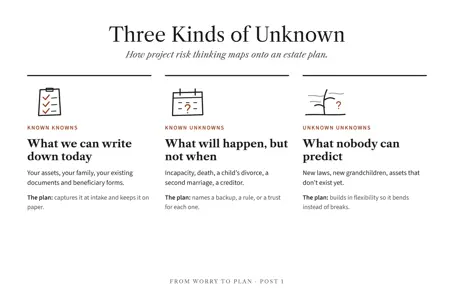
Most estate planning content is written for people who have never thought about risk in a structured way. This post is for people who think about it every day: engineers, project managers, finance and compliance professionals, safety officers, and anyone who has ever filled out a risk register or sat through a failure review. If that's you, the rest of this series will read as plain-language versions of ideas you already use at work. This post is the translation key.
The short version: an estate plan is a risk control system for a family. It identifies what can go wrong, assigns owners, sets contingencies, and needs periodic testing like any other control system. Planning converts as much uncertainty as possible into named, managed risk, and builds tolerance for the rest.
Risk vs. uncertainty
In 1921, economist Frank Knight drew a distinction that still holds up. Risk is a future outcome you can identify and at least roughly characterize. Uncertainty is an outcome you can't identify or measure at all.
Most people walk into an estate planning meeting carrying uncertainty. They have a general sense that something could go wrong for their kids, their spouse, or their property, but they can't say what. The first job of planning is risk identification: turning that diffuse uncertainty into a list of specific, describable events. Only identified risks can be assigned a response.
The three categories
Project management practice sorts the future into three categories, and they map cleanly onto planning work.
| Category | Project management meaning | Estate planning equivalent | How the plan handles it |
|---|---|---|---|
| Known knowns | Facts and fixed requirements | Assets, family members, existing documents, beneficiary designations | Captured at intake and documented |
| Known unknowns | Identified risks with uncertain probability or timing | Incapacity, death of a parent with minor children, a beneficiary's divorce, creditor claims, a second marriage | Specific provisions: named successors, contingent beneficiaries, spendthrift terms, staggered distributions |
| Unknown unknowns | Risks that can't be identified in advance | Changes in law, family structure decades out, asset types that don't exist yet | Flexibility: trust protectors, discretionary standards, powers of appointment, amendment and decanting authority where state law allows |
The budgeting analogy is useful. Projects carry a contingency reserve sized to identified risks, and a separate management reserve for risks nobody can name. A well-drafted plan has both. Named successor trustees and contingent beneficiaries are contingency reserve. A trust protector who can fix an administrative provision after a law change is management reserve.
In practice, most of what clients think is unpredictable turns out to be a known unknown. Incapacity, death, and family conflict are predictable in the statistical sense. They are risks waiting to be written down.
Risk responses
Once a risk is identified, the standard PMBOK-style responses apply directly.
| Response | What it means | Planning examples |
|---|---|---|
| Avoid | Change the plan so the risk can't occur | Funding a revocable trust so assets avoid probate; not naming a high-conflict relative as fiduciary |
| Mitigate | Reduce probability or impact | Co-trustees, staggered distributions, a spendthrift clause, clear decision-making authority |
| Transfer | Shift the impact to another party | Life insurance; a professional or corporate trustee |
| Accept | Knowingly retain the risk | Leaving a small account to pass under a simple will because the cost of more planning exceeds the exposure |
Acceptance deserves emphasis because clients rarely hear it from attorneys. Some risks cost more to control than they are worth. A good plan documents which risks were accepted on purpose, so the record shows a deliberate choice.
There is also an opportunity side. Project managers talk about exploiting or enhancing positive risks. In estate planning, that's mostly tax planning, charitable giving, and timing transfers well. It matters, but for most families in Illinois and Iowa the larger exposures are on the threat side.
Probability and impact, without the scoring
A risk matrix plots each risk by likelihood and consequence. We use the same logic, though we keep it qualitative. Putting a number on a family conflict feels clinical, and the inputs are too soft to justify false precision.
The matrix still drives priorities, and it shifts with life stage:
Young parents (mid-20s to early 40s). Death of both parents before the kids are grown is low probability and catastrophic impact. That profile calls for transfer (term life insurance) and a few specific controls: named guardians, and a trust so a minor doesn't receive a lump sum at 18.
Clients in their 60s and 70s. Incapacity moves from low to high probability. Powers of attorney, health care directives, and a funded trust move to the top of the list, along with the predictable friction points between adult children.
Same framework, different heat map.
The pre-mortem
The most useful identification technique I've borrowed is the pre-mortem, popularized by psychologist Gary Klein. Instead of asking a team what might go wrong, you tell them the project has already failed and ask them to explain why. Researchers call this prospective hindsight, and it reliably surfaces risks that a standard brainstorm misses.
In a planning meeting it sounds like this: "It's ten years after you're gone, and your family is in a courtroom. What happened?" People almost always have an answer, and it is usually the most important risk in the plan.
Lessons learned from the litigation side
Our firm handles probate disputes and trust litigation as well as planning. That gives us something like a lessons-learned database: a steady stream of plans that failed in the field. The failure modes repeat:
Trusts that were signed but never funded, so the assets went through probate anyway
Beneficiary designations that contradicted the will or trust
A single named fiduciary with no successor, or a successor who was no longer willing or able to serve
Documents that weren't executed correctly under the law of the state where they were signed
Verbal understandings ("Mom always said I'd handle everything") that no document supported
Plans that were fine when signed and quietly drifted out of date
Every one of these is a control failure in an otherwise sound plan. That distinction drives the second half of this framework.
From project to program: the ERM view
Project management has a weakness as a model for estate planning. Projects close. A plan stays open. The family keeps living, the assets keep changing, and the law keeps moving after the signing ceremony.
Enterprise risk management is the better model for everything after signing. Frameworks like COSO ERM and ISO 31000 treat risk management as a continuous cycle: identify, assess, respond, monitor, repeat. Several ERM concepts translate directly.
| ERM concept | What it means in an organization | What it means for a family's plan |
|---|---|---|
| Risk appetite | How much risk the organization will tolerate to meet its goals | How much control, cost, and complexity the client wants; it shifts with age and family stage |
| Risk owner | The person accountable for a given risk | Named fiduciaries: agents, executors, trustees, guardians |
| Key risk indicators | Early warning signals that a risk is rising | Life events: marriage, divorce, birth, death, diagnosis, a move to another state, a business sale, an inheritance |
| Control decay | Controls that degrade quietly over time | A trustee who moved away or fell ill; an agent who no longer speaks to the family |
| Control testing | Verifying controls actually work | Confirming the trust is funded, designations match the plan, and named fiduciaries are still willing and able |
| Residual risk | Risk remaining after controls | What the client knowingly accepted, and whether it has grown since |
| Emerging risk | New risks not yet on the register | Law changes, new asset types, a beneficiary's new circumstances |
The practical difference is staffing. A company has a risk function whose job is to keep the cycle running. A family has busy people with other priorities. So the attorney ends up supplying part of the monitoring function, and the client supplies the early warning signals. We generally suggest a check-in at least every two years, plus a call whenever one of those life events happens.
Some readers will recognize the three lines model here. The client and named fiduciaries are the first line: they live with the plan and operate it. The documents and the process around them are the second: they set the rules and the reporting. A periodic attorney review is the closest thing a family has to an independent third line.
An engineer's reading
If your background is in systems or safety engineering, a few more translations may help.
Single point of failure. One named executor with no successor is a single point of failure. So is one person who knows where all the accounts are.
Redundancy. Successor fiduciaries and contingent beneficiaries are redundant paths. They cost almost nothing to include and carry most of the load when something goes wrong.
Defense in depth. A durable power of attorney, a funded revocable trust, and updated beneficiary designations are separate layers. Each catches failures the others miss.
FMEA. Failure mode and effects analysis asks, component by component, how each part could fail and what happens downstream. A careful plan review does the same thing document by document.
Configuration control. A will, a trust, deeds, and beneficiary designations all have to agree. When one changes and the others don't, the system is out of configuration, and the most specific document usually wins whether or not it reflects current intent.
Where the analogy breaks
These frameworks are useful, but a family is not an enterprise, and I want to be clear about the limits.
Values set the target. Two clients with identical risk profiles can want opposite outcomes, and both are right. The framework organizes the conversation; decisions remain the purview of our clients.
The inputs are soft. A sibling dispute resists any real probability estimate. That's why we keep assessment qualitative.
The rules are local. What counts as a valid will, how probate works, and which tools are available all vary by state. Illinois and Iowa share a river and keep separate probate codes. (Georgia has its own differences again.)
People carry out plans. Plans are carried out by people at the worst moments of their lives. Simple, clear, and well-communicated beats clever.
The rest of the series
The remaining posts take these ideas out of the jargon and into ordinary language.
Post 2: The Difference Between a Worry and a Risk
Post 3: Imagine It Went Wrong: A Pre-Mortem for Your Family
Post 4: Four Ways to Handle Any Risk
Post 5: Planning for What Nobody Can Predict
Post 6: Your Plan Is Aging Even If You Aren't Looking
Post 7: What a Plan Review Actually Looks Like
Post 8: One Family, Two States: Planning in the Quad Cities
Post 9: What Happens Without a Plan in Cook County
Post 10: New Baby, New Plan: A Checklist for Frankfort Families
If you work in a technical field and want to talk through your own plan in these terms, use the chat on this page. We're happy to have that conversation in your language.
About the Author
James D. Greenwood is the managing attorney and founder of Greenwood Law, LLC, a veteran-owned firm serving the Quad Cities, the Chicago area, and Atlanta. He is licensed in Illinois, Iowa, and Georgia, and his practice includes estate planning, probate, guardianship, and trust litigation.
Before law, James spent eight years in the U.S. Navy as a nuclear electrician on submarines, leaving as an Electrician's Mate First Class. Submarine nuclear work runs on procedure, redundancy, and assuming every system will eventually fail, which is a fair description of how he approaches an estate plan.
He holds a B.A. from the University of Massachusetts Amherst, a J.D. and an M.B.A. from Drake University, and an LL.M. in Taxation from Villanova University. Before founding Greenwood Law in 2022, he practiced at Winstein, Kavensky & Cunningham and worked as a financial counselor with Army Survivor Outreach Services at Rock Island Arsenal, helping families of fallen soldiers through the financial aftermath of a loss.
This post is general information, not legal advice. Every family's situation is different, and you should talk with an attorney licensed in your state. James D. Greenwood is the attorney responsible for this content.